
How to Sell Inherited Land When the Deed Is Still in a Deceased Parent’s Name
Why a parent’s name on the deed stops a land sale
A deceased parent cannot sign closing papers. So a buyer and title company will want proof that someone else can legally transfer the land.
A will, paid taxes, or sibling agreement does not change the public record by itself. An as-is sale does not fix this, because “as-is” covers condition, not ownership.
Next steps depend on how your parent held title and the law where the land sits. This is general information, not legal or tax advice.
A local attorney or title professional can confirm your path.
Start with how your parent held title
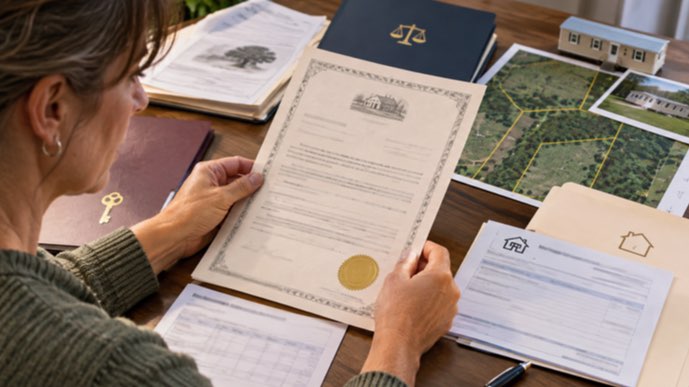
Get a copy of the deed from the county recorder. Its wording often shows whether probate is needed.
| Title type | Usual result at death | What a sale may need |
|---|---|---|
| Parent’s name alone | Land stays in the estate | Probate or another court process |
| Joint tenancy with right of survivorship | Passes to the surviving co-owner | Death certificate and recorded survivorship document |
| Tenancy in common | Parent’s share passes by will or state law | Authority over that share and possibly all co-owners’ signatures |
| Living trust | Successor trustee takes control | Trust documents showing trustee authority |
| Transfer on death or beneficiary deed | Passes to the beneficiary if state law allows it and it was recorded before death | Death certificate and any required affidavit |
Check two other details early. A mobile home may be titled like a vehicle or as real property, which changes the paperwork.
Debts are generally paid from the sale proceeds. These may include a mortgage, liens, unpaid taxes, or a Medicaid estate recovery claim.
Common ways heirs gain authority to sell
Land in a parent’s name alone often needs probate. A court then names a personal representative to sign the deed.
This is an executor if there is a will or an administrator if not. Probate’s deadlines for creditor claims help buyers trust the title.
Simpler tools vary by state. Colorado’s and Washington’s small estate affidavits apply only to personal property, so neither can transfer real estate.
Tennessee has its own affidavit process with set conditions.
Heirs’ property is harder. When an owner died years ago without a settled estate, ownership can split among many descendants.
Some may not know they hold a share. Clearing that title usually starts with a title search.
Options may include probate if still available, an heir agreement, or a quiet title lawsuit asking a court to confirm ownership.
When several heirs share the land

Heirs who already co-own the land generally must all sign. During probate, however, a personal representative with authority may sell without every heir’s consent.
Still, contested sales can reach court.
If co-owners cannot agree, one can typically ask a court for a partition, where the court may divide the land or order it sold. Forced sales tend to be slower, more public, and costlier than private ones.
Some states have adopted the Uniform Partition of Heirs Property Act. It can let co-owners buy out an heir who wants to sell.
A neutral appraisal, mediation, or a buyout can help families avoid court.
Living far from the land and the cost of waiting

Distance adds steps. In Colorado, out-of-state heirs usually need a Colorado court case to sell land there.
Tax bills and notices may keep going to the deceased owner, raising the risk of missed payments. Meanwhile, taxes, insurance, and upkeep add up, and distant owners tend to draw lowball offers.
Choosing whether to hold, list, or sell as-is

Once someone can sign, the choice is practical.
- Holding or leasing can work when heirs agree and can cover taxes and upkeep.
- A traditional listing often fits when title is clean and the family can wait. It may bring a higher price.
- An as-is sale can suit vacant land, out-of-state heirs, or families facing ongoing costs.
Under Internal Revenue Code Section 1014, inherited property generally gets a stepped-up basis. Its tax basis becomes its fair market value on the date of death, which can lower taxable gain.
A date-of-death appraisal helps prove that value, and a tax professional can explain how it applies.
How Smiles for Land evaluates inherited land
Our owner’s perspective comes from passive investment in land-flipping deals led by another investor. That gave firsthand exposure to how vacant-land deals are evaluated, structured, funded, and carried through to resale or disposition.
We review each parcel on its own, looking at access, zoning, terrain, taxes, title, and utilities. Wetlands, market demand, recent sales, and ownership complications also matter.
Smiles for Land buys vacant, rural, inherited, unwanted, and hard-to-manage land nationwide when it fits our criteria. You talk directly with the owner.
Independent title or closing professionals verify ownership, prepare documents, and coordinate closing. Heirs may ask for a direct parcel review if they live far away or want to avoid retail listing preparation.
They may also want to know whether land with ownership complications can be bought as-is. Sharing the deed, death certificate, any will or trust, and all heirs’ names helps that review.
Settle who can sign before you choose how to sell

Inherited land can often be sold once the right person has legal authority. Starting with the deed and involving co-heirs early can keep the process moving.
Frequently Asked Questions About Selling Inherited Land
Can I sell inherited land if my parent’s name is still on the deed?
Usually not until someone gains legal authority to sign.
Does a will let me sell the land without probate?
Often not, because the will may need to go through probate first.
Can a small estate affidavit transfer inherited land?
It depends on the state, and some states do not allow it for real estate.
Do all heirs have to agree to sell?
Co-owners generally all need to sign, though a personal representative may not need unanimous consent.
What if my parent died years ago and no one opened probate?
A professional title search is a common first step to learn who holds shares.
Want a Cash Offer for Your Land?
Tell us about the property. There is no obligation, and you can compare the offer with your other options.
GET MY CASH OFFER